Here’s a fun activity for all ages with vocabulary that is tied to Constitution Day! Answers are provided as well!
Constitution Day Writing Prompts – Middle and High School
Three writing prompts for Constitution Day are provided for middle school and high school. The prompts can be used as a formal essay, at writing stations, or as a “discuss and write.”
Making the Constitution (CKHG Unit)
Students who listen to this Grade 2 Core Knowledge History and Geography unit discover that Americans had a difficult task at hand after winning the Revolutionary War: they had to figure out a better way to govern themselves. Such leaders as James Madison, George Washington, Alexander Hamilton, and Benjamin Franklin traveled to Philadelphia to meet at the Constitutional Convention, with the goal of creating a new government. Students learn that the talks were held in secret in Independence Hall and that American leaders argued about many issues until they agreed to approve a new Constitution. They then hear that James Madison (whom we call the Father of the Constitution), along with John Jay and Alexander Hamilton, wrote the Federalist Papers to explain the document’s merits and to persuade the states to vote for it. Students find out that the states did finally approve the Constitution; that Madison wrote a Bill of Rights that was added to it; that the Constitution gives the American people the right to decide what the laws should be for our country; and that we can still amend it today.(5 lessons)
Declaration Revisited: Declaration of Sentiments Podcast
The Declaration of Independence called George III a tyrant. And in 1848, a group of women’s rights activists mirrored our founding document to accuse men of the same crime. Today in our final revisit to the Declaration of Independence, we explore the Declaration of Sentiments, the document at the heart of the women’s suffrage movement.
Our guest is Laura Free, host of the podcast Amended and professor at Hobart and William Smith Colleges.
This short episode includes a one-page Graphic Organizer for students to take notes on while listening, as well as discussion questions on the back side.
Distance Learning: Civics for Civic Engagement in the Federal Courts
Distance learning activities become civics for civic engagement when federal judges bring the rule of law, separation of powers, judicial independence, and jury service into students’ daily life. Student voice is incorporated into every activity. Teachers and students can explore the pillars of literacy: rule of law, separation of powers, and judicial independence. With the guidance of federal judges and attorney volunteers in virtual court hearings, students learn and practice civil discourse skills as the foundation of effective dispute resolution in the law and in life.
14th Amendment: Battles for Equality
The 14th Amendment wrote the Declaration of Independence’s promise of freedom and equality into the Constitution. It transformed the Constitution forever. And it’s at the heart of what many scholars refer to as America’s “Second Founding.” Even so, the 14th Amendment is the focus of many of the most important constitutional debates (and Supreme Court cases) today. In many ways, the history of the modern Supreme Court is really a history of modern-day battles over the 14th Amendment’s meaning. Nearly every constitutional case that you care about today turns on the 14th Amendment.
The Electoral College Process
In this activity, students will learn the steps in the Electoral College process, from Election Day to Inauguration Day. They will analyze historical primary sources from various Presidential elections, each representing a different step in the process, and arrange them in the correct sequence.
Constitution Day Writing Prompts – K-3
September 17 is Constitution Day! We have created different writing prompts along with the writing space for students. These writing prompts can be used as individual assignments, at writing stations, or even for group discussions!
Earth Day Activities
You will find a suite of activities for families, teens and educators to celebrate Earth Day. Take on a Green Challenge to design a creative solution for an environmental issue, explore examples of climate activism, and learn how legislators consider a climate-ready policy issue.
The Road to Independence
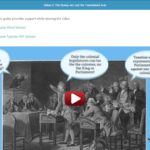
This resource provides students with an English language video and associated student friendly readings (in English, Spanish, and Haitian Creole), as well as reading and video guides and self assessment tools. Using these, students will explore the road to independence and key events along the path to the Declaration of Independence!
Free registration is required to use the resource.