The Impact of Congress looks at the work of the First Congress, 1789-91, and its impact on the country over the years. In this module you will learn about eleven of the First Congress’s most important accomplishments through primary source images and documents – accomplishments that still have a major impact on our country today. Then you will pick a later session of Congress and explore and analyze its accomplishments.
District of Columbia Compensated Emancipation Act of 1862
The 150th anniversary of the District of Columbia Compensated Emancipation Act of 1862
occurred in 2012. This bill was introduced to Congress to end slavery in the District of
Columbia. Many citizens and members of Congress alike noted that the legality of slavery in
the District of Columbia was inconsistent with the ideals and aspirations of the nation. Congress
approved the bill, and President Abraham Lincoln signed the act.
This activity features the District of Columbia Compensated Emancipation Act of 1862 and
other primary and secondary sources that tell the story of Congress’s role in this first major step
toward the freeing of enslaved African Americans. While intended for 8th grade students, the
lesson can be adapted for other grade levels.
The U.S. Constitution: Continuity and Change in the Governing of the United States
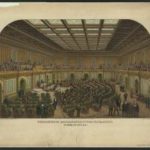
This unit examines continuity and change in the governing of the United States. Lessons one and two are focused on a study of the Constitution and Bill of Rights and provide access to primary source documents from the Library of Congress. Lesson three investigates important issues which confronted the first Congress and has students examine current congressional debate over similar issues. Lesson four features broadsides from the Continental Congress.
First Amendment Overview
Congress shall make no law respecting an establishment of religion, or prohibiting the free exercise thereof; or abridging the freedom of speech, or of the press; or the right of the people peaceably to assemble, and to petition the Government for a redress of grievances.
Congress and the Creation of the Bill of Rights
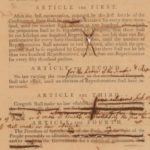
Students will explore the protections and limitations on authority contained in the Bill of Rights and the process by which the First Congress created it. They will do this by compiling a list of their rights as students, analyzing the Bill of Rights, and studying primary source documents to trace the origin and development of the first ten amendments. Students will then consider how the Bill of Rights might be updated to reflect 21st century circumstances. (Duration: 30–90-minute segments, up to 5 hours.)
Congress Creates the Bill of Rights
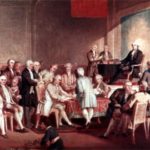
Within the half-billion pages of records in the care of the Center for Legislative Archives, there are some special treasures from the First Congress that show how the ratification of the Constitution necessitated the creation of the Bill of Rights, and how the creation of the Bill of Rights, in turn, completed the Constitution. This remarkable story is told in Congress Creates the Bill of Rights, which consists of a mobile app, an ebook, and online resources for teachers and students.
The 19th Amendment: Part 2 Podcast
The Nineteenth Amendment was first introduced to Congress in 1878. It took over four decades of pleas, protests, petitions and speeches to finally get it ratified. We’re told that the Nineteenth granted all women the right to vote in America — but this was not the case in practice. How did the divides in the suffrage movement define the fight for women’s enfranchisement? And how did that amendment finally get passed? With a stern note from someone’s mom.
Our guests are once again historians Martha Jones of John Hopkins University, Laura Free of Hobart and William Smith Colleges and Lisa Tetrault of Carnegie Mellon University.
This short episode includes a one-page Graphic Organizer for students to take notes on while listening, as well as discussion questions on the back side.
The 14th Amendment and the Evolution of Title IX
Congress and the courts have applied the 14th Amendment’s equal protection clause to many aspects of public life over the past 150 years. In this activity, students will explore the evolution of the 14th Amendment through the lens of Title IX, which prohibits institutions that receive federal funding from excluding students from participating in educational and athletic programs on the basis of sex. The Supreme Court’s first Title IX case, Grove City College v. Bell, also demonstrates how each of the three branches exercises its authority.
United States Founding Documents
A gallery of study resources about significant primary source documents from American history. This gallery highlights resources designed to enhance study of a few significant primary source documents from American history.
The Acts of Congress
George Washington’s copy of the Acts passed at a Congress of the United States of America (New-York, 1789) contains key founding documents establishing the Union: the Constitution, the Bill of Rights, and a record of acts passed by the first Congress. In the margins, Washington wrote “President,” “Powers,” and “Required,” underscoring the responsibilities of the first Chief Executive. Learn more about this rare volume in the Fred W. Smith National Library for the Study of George Washington.