In 1998, when Lilly Ledbetter filed her complaint of wage discrimination against the Goodyear Tire and Rubber Co. with the Equal Employment Opportunity Commission, her goal was to get equal pay for equal work because that was the law. She had no idea that her decision would eventually involve all three branches of government and result in a law with her name on it – the Lilly Ledbetter Fair Pay Act of 2009.
Equal Justice Under Law
In its first constitutional challenge to the equal protection clause of the Fourteenth Amendment, the U.S. Supreme Court decided to hear a case brought by a Chinese immigrant, not an American citizen. Yick Wo believed city ordinances had been unfairly applied to him, so he challenged their constitutionality under the equal protection clause, and took his case all the way to the Supreme Court.
How a Bill Becomes a Law – Clean Water Act of 1972
The Federal Water Pollution Control Act, commonly known as the Clean Water Act, was originally passed in 1948. By 1972, Congress had voted on an amended version of the law that included the expansion of regulations to prevent pollution of the nation’s waterways. In this lesson, students consider how the Clean Water Act of 1972 became a law. They identify key moments in the evolution of this bill including its path in Congress, its veto by President Nixon and its eventual enactment. Preparing and organizing information, students interpret these key events and share them in a storyboard presentation. While intended for 8th grade students, the lesson can be adapted for other grade levels.
District of Columbia Compensated Emancipation Act of 1862
The 150th anniversary of the District of Columbia Compensated Emancipation Act of 1862
occurred in 2012. This bill was introduced to Congress to end slavery in the District of
Columbia. Many citizens and members of Congress alike noted that the legality of slavery in
the District of Columbia was inconsistent with the ideals and aspirations of the nation. Congress
approved the bill, and President Abraham Lincoln signed the act.
This activity features the District of Columbia Compensated Emancipation Act of 1862 and
other primary and secondary sources that tell the story of Congress’s role in this first major step
toward the freeing of enslaved African Americans. While intended for 8th grade students, the
lesson can be adapted for other grade levels.
Provide for the General Welfare – Interstate Highway and Defense Act
In the Constitution, Congress is charged with providing for the general welfare of the country’s
citizens. Historically, this has meant improving transportation, promoting agriculture
and industry, protecting health and the environment and seeking ways to solve social and
economic problems. In 1956, Congress passed the Federal-Aid Highway Act, popularly known as the National Interstate and Defense Highways Act, authorizing federal funding for the extension and
construction of a robust network of interstate highways. This project was one of the largest public
works in U.S. history establishing key transportation infrastructure that impacted lives of all
Americans — changing communities, access and economic possibilities and also providing key
routes for evacuating urban centers — a critical national defense issue in the Cold War era.
Analyzing primary source material, students discuss the origins and reasons for the National
Interstate and Defense Highways Act. Then, they work with historical and contemporary maps
as they consider the impact this important congressionally funded project. While intended for 8th
grade students, the lesson can be adapted for other grade levels.
A Call to Act: Ledbetter v. Goodyear Tire and Rubber Co.

This documentary tells the story of Lilly Ledbetter, whose fight for equal pay for equal work eventually involved all three branches of government and resulted in a law with her name on it — the Lilly Ledbetter Fair Pay Act of 2009. A PDF lesson plan accompanies this video.
Civil Rights
While the Reconstruction Amendments were an important step in ensuring equal rights for all people, regardless of race, racial injustices throughout the United States continued into the late 19th and 20th centuries, leading to the Civil Rights movement of the 1960s, and the passages of Supreme Court decisions and legislation, including Brown v. Board of Education, the Civil Rights Act of 1964, and the Voting Rights Act of 1965. Visit the National Constitution Center’s learning module to learn more about the freedom struggle and civil rights.
Equal Protection Under Law
In this lesson, students will analyze the Fourteenth Amendment’s Equal Protection clause. They will distinguish between identical treatment and equal treatment under the law, and discuss situations in which discrimination is acceptable – not letting a 6-year-old obtain a driver’s license, for example.
The 14th Amendment and the Evolution of Title IX
Congress and the courts have applied the 14th Amendment’s equal protection clause to many aspects of public life over the past 150 years. In this activity, students will explore the evolution of the 14th Amendment through the lens of Title IX, which prohibits institutions that receive federal funding from excluding students from participating in educational and athletic programs on the basis of sex. The Supreme Court’s first Title IX case, Grove City College v. Bell, also demonstrates how each of the three branches exercises its authority.
The Power of One Decision: Brown v. Board of Education
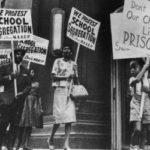
When minority students decided to take their challenge of the “separate but equal” doctrine to the Supreme Court, the 1954 decision handed down by the court in Brown v. Board of Education and enforced by the executive branch, changed their lives and America forever. In this lesson plan, based on the Annenberg Classroom video “A Conversation on the Constitution: Brown v. Board of Education,” students gain insight into decision-making at the Supreme Court, learn about the people behind the case, construct a persuasive argument, and evaluate the significance of Brown v. Board of Education.