This video playlist is part of the New-York Historical Society’s Academy for American Democracy, an educational initiative focusing on history and civics education for sixth grade students. Videos explore the ideals of democracy, civic participation, the evolution of Ancient Athenian and American democracy, and the power of the people within democracies.
Making the Constitution (CKHG Unit)
Students who listen to this Grade 2 Core Knowledge History and Geography unit discover that Americans had a difficult task at hand after winning the Revolutionary War: they had to figure out a better way to govern themselves. Such leaders as James Madison, George Washington, Alexander Hamilton, and Benjamin Franklin traveled to Philadelphia to meet at the Constitutional Convention, with the goal of creating a new government. Students learn that the talks were held in secret in Independence Hall and that American leaders argued about many issues until they agreed to approve a new Constitution. They then hear that James Madison (whom we call the Father of the Constitution), along with John Jay and Alexander Hamilton, wrote the Federalist Papers to explain the document’s merits and to persuade the states to vote for it. Students find out that the states did finally approve the Constitution; that Madison wrote a Bill of Rights that was added to it; that the Constitution gives the American people the right to decide what the laws should be for our country; and that we can still amend it today.(5 lessons)
Dialogue on the Fourteenth Amendment
The American Bar Association Dialogue program provides lawyers, judges and teachers with the resources they need to engage students and community members in a discussion of fundamental American legal principles and civic traditions. This Dialogue on the Fourteenth Amendment is composed of three parts:
Part 1: Equal Protection and Civil Rights – Participants discuss the equal protection clause of the 14th Amendment and consider how Congress, through federal legislation, has worked to help realize its constitutional promise.
Part 2: Incorporating the Bill of Rights examines the concept of incorporation. Using a case study of Gitlow v. New York, this section provides a guide to how courts have applied the Bill of Rights, selectively, to the states using the 14th Amendment.
Part 3: Ensuring Equality and Liberty explores how the 14th Amendment has been interpreted by courts to protect fundamental freedoms, including individuals’ right to marry.
American Legal History: Colonial Era to 1800
Larry Kramer, former Dean of Stanford Law School and constitutional scholar, discusses American legal history, beginning with Marbury v. Madison.
Women During the American Revolution

This short video illustrates the degree to which women actively participated in the American Revolution. In response to the Stamp Act, American colonists agreed to stop importing British goods and the colonial women led the boycotts of tea, fine cloth, and other consumer goods. Women began to think of themselves as “Daughters of Liberty.” Professor Rosemarie Zagarri explains how male political leaders came to acknowledge the political capacity and potential of women during this era.
‘It’s An American Thing!’
Looking for ice breakers for classroom starters? Can 30 seconds make a difference in your classroom? Constituting America’s Best High School PSA by Dakare Chatman, “It’s an American Thing!” creates thought, excitement and a challenge for your students. You need a method to begin class? Look no further.
‘Speech Is More Than Speaking’
“Speech Is More Than Speaking” is a We The Future Contest winner for Best Short Film by Jacob VanDerwerken. What is Freedom of Speech if you cannot speak? Using American Sign Language, Jacob VanDerwerken explains the First Amendment’s Freedom of Speech is not just verbal language. This video is a discussion starter for students and adults.
The Constitution as a Fulfillment of the American Revolution
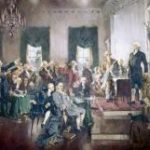
This short video challenges the notion that the Constitution was a conservative reaction to the democratic ideals of the American Revolution. The Revolution generated constitutional discussion in the states, where legislators explored the nature of executive power, and other constitutional questions. In light of this constitutional innovation, Professor Jack Rakove maintains that the Constitution of 1787 was the culmination of—not a reaction to–the Revolution of the late 1770’s.
The History of Flag Day
This lesson highlights one of the Center’s biggest civic holidays —the birthday of the American flag. Using “The History of the U.S. Flag,” a video hosted by Terry Ruggles and produced by Drexel University and the Philadelphia Flag Day Association, this lesson encourages students to take a closer look at the American flag and its meaning.
Founding Documents: Federalist and Anti-Federalist Papers Podcast
Ten days after the Constitution was signed at the Old Philadelphia State House, an anonymous op-ed appeared in the New York Journal. Signed by “”Cato,” it cautioned readers of the new Constitution to take it with a grain of salt. Even the wisest of men, it warned, can make mistakes. This launched a public debate that would last months, pitting pro-Constitution Federalists against Constitution-wary Anti-Federalists. It was a battle for ratification, and it resulted in a glimpse into the minds of our Framers – and a concession that would come to define American identity.
Our guides through the minds of the Federalists and Anti-Federalists are Claire Griffin and Cheryl Cook-Kallio.
This short episode includes a one-page Graphic Organizer for students to take notes on while listening, as well as discussion questions on the back side.