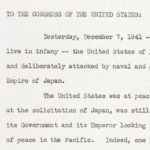
This lesson will explore the implementation of the war-making power from the first declared war under the Constitution—the War of 1812—to the Iraq War. Using primary sources, students will investigate how the constitutional powers to initiate war have been exercised by the legislative and executive branches at several key moments in American history. They will also evaluate why and how the balance of authority in initiating war has changed over time, and the current balance of power.
Core Documents Collection: The Cold War
This collection of documents on the Cold War continues TeachingAmericanHistory.org’s extended series of document collections covering major periods, themes and institutions in American history and government. The volume covers American aid to Europe in the early years of the Cold War and American intervention in subsequent years in conflicts around the world to contain the spread of Soviet power. Its documents also explore the dometic effects of the Cold War, chronicling how national security concerns affected relations between American citizens and between Americans and their government. Each volume includes:
Key documents on the period, theme or institution, selected by an expert and reviewed by an editorial board
A thematic table of contents, showing the connections between various documents
Study questions for each document as well as questions that refer to other documents in the collection
Notes on each document to identify people, events, movements, or ideas to improve understanding of the document’s historical context
Major Events of the Cold War
In this lesson, students will use short video clips to learn about major events occurring during the Cold War, the causes of these events, and their impact on the U.S., Soviet Union, and the world. Students will summarize this information by providing a written response that analyzes the legacy of the Cold War.
Women & the American Story: A Nation Divided, 1832-1877
This free curriculum unit from the New-York Historical Society delves into the ways women participated in all aspects of the Civil War and on both sides of the conflict, from the early debate over the expansion of slavery through the end of federal Reconstruction. Materials examine this pivotal moment in American history through the experiences of diverse women and consider how the war and then Reconstruction policies shaped their lives.
NHD Breaking Barriers: Americans and Native Americans
From the colonial era, relations between European settlers and Native American nations have been complicated. In 1803 Congress authorized and funded an expedition led by Meriwether Lewis and William Clark for exploration of the region and for better knowledge about American Indians of the Northwest in order to develop trade. About 30 years later, the United States forced the removal of Native Americans from their lands to make way for white American settlement. Congress and the president made treaties with Native American nations, but those treaties were not always respected as the United States continued to expand into the west. After Native Americans enlisted and served in both World War I and World War II, Congress passed legislation to begin to address longstanding Native Americans claims against the United States Government.
Women’s Contributions in the Civil War
In this lesson, students will view videos to visit Civil War-related sites in Alexandria, Va., where women worked as nurses, sold goods to soldiers and aided communities of newly-freed slaves.
Cold War Document Based Question
Utilizing primary source documents from the archives of Presidents Truman, Eisenhower, Kennedy, Nixon, and Reagan, this piece of curriculum is modeled after the Advanced Placement Document Based Questions. This question invites students to explore U.S. Cold War foreign policy through the lens the office of the presidency, and to develop crucial critical thinking and writing skills.
The History of Memorial Day

This lesson takes a closer look at the history of Memorial Day by examining World War I, World War II, and the Vietnam War and their connections to this civic holiday.
America and Red Scare
The Cold War was sparked by the immediate aftermath of World War II. The Allied Forces were divided by ideology and quickly separated into two camps: the Western democracies, led by the United States, and the Communist nations, dominated by the Soviet Union. This alignment served as the basic framework of the Cold War over the next fifty years, from 1947-1991. As America positioned itself in opposition to totalitarian regimes, American citizens were forced to confront realities of what “freedom” meant, or should mean.
Making the Constitution (CKHG Unit)
Students who listen to this Grade 2 Core Knowledge History and Geography unit discover that Americans had a difficult task at hand after winning the Revolutionary War: they had to figure out a better way to govern themselves. Such leaders as James Madison, George Washington, Alexander Hamilton, and Benjamin Franklin traveled to Philadelphia to meet at the Constitutional Convention, with the goal of creating a new government. Students learn that the talks were held in secret in Independence Hall and that American leaders argued about many issues until they agreed to approve a new Constitution. They then hear that James Madison (whom we call the Father of the Constitution), along with John Jay and Alexander Hamilton, wrote the Federalist Papers to explain the document’s merits and to persuade the states to vote for it. Students find out that the states did finally approve the Constitution; that Madison wrote a Bill of Rights that was added to it; that the Constitution gives the American people the right to decide what the laws should be for our country; and that we can still amend it today.(5 lessons)