These cases are about whether states are required to license same-sex marriages or to recognize lawful same-sex marriages performed in other states. In 2013, the Supreme Court ruled that one part of the federal Defense of Marriage Act was unconstitutional under the Fifth Amendment and the federal government had to treat same-sex married couples the same as all other married couples. Does the Fourteenth Amendment require states to do the same? Moreover, does the Fourteenth Amendment require that all states permit marriages between two people of the same sex?
Title IX
Title IX of the Education Amendments Act of 1972 prohibited discrimination on the basis of sex in educational settings. The law applied to any educational institution that received federal funding. This lesson has students learn about what Title IX does and explore its impact on gender equality today.
The Equal Rights Amendment (ERA)
The Equal Rights Amendment (ERA) stated, “Equality of Rights under the law shall not be denied or abridged by the United States or any state on account of sex.” This proposed amendment was passed by Congress in 1972 but failed to be ratified by three-fourths of the states. This lesson provides an overview of the proposed amendment, arguments for and against ratification and possible future steps toward ratification. This lesson can be used in a traditional or flipped classroom.
The 14th Amendment and the Evolution of Title IX
Congress and the courts have applied the 14th Amendment’s equal protection clause to many aspects of public life over the past 150 years. In this activity, students will explore the evolution of the 14th Amendment through the lens of Title IX, which prohibits institutions that receive federal funding from excluding students from participating in educational and athletic programs on the basis of sex. The Supreme Court’s first Title IX case, Grove City College v. Bell, also demonstrates how each of the three branches exercises its authority.
The Amendment Process: Ratifying the 19th Amendment
In this activity, students will analyze historical records of Congress and the U.S. government to understand the sequence of steps in the amendment process. Students will study each document and match it to the step in the process that it illustrates.
When put in proper sequence, the documents will show the process by which the 19th Amendment – prohibiting the federal government or states from denying the right to vote on the basis of sex – was added to the Constitution.
Then students will reflect on the process, and the roles that the people, president, Congress and the states play.
Teaching LGBT Rights
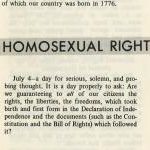
The history of equal rights for members of the LGBT community is something often overlooked in classroom curriculum. With the Supreme Court ruling that same-sex marriage is a constitutional right, it is important to look back at the men and women who fought for equality, especially right here in Philadelphia. Events, such as Reminder Day, are examples of how we can remember the contribution of men and women in the community who fought for their rights as citizens.
Hollingsworth v. Perry (2013)
Does the 14th Amendment’s Equal Protection Clause prohibit California from defining marriage as the union of one man and one woman? This case summary shows how the Supreme Court answered that question in 2013.
Jackson v. Birmingham Board of Ed. (2005)
Does Title IX allow suits for retaliation for complaints about unlawful sex discrimination? This case summary shows how the Supreme Court answered that question in 2005.
Lawrence v. Texas (2003)
Does a Texas law that criminalizes sexual intimacy by same-sex couples violate the Fourteenth Amendment? This case summary shows how the Supreme Court answered that question in 2003.
Smith v. Doe (2003)
Does Alaska’s Sex Offender Registration Act violate the Ex Post Facto Clause? This case summary shows how the Supreme Court answered this question in 2003.