In this lesson, students will consider a proposed teen curfew law in a mock city council session. The class is divided into groups; one group is the city council, and the others represent the interests of groups of citizens – merchants association, county school board, etc. This exercise helps show students how citizens can be involved in policy change and decision making.
Brown v. Board of Education (1954) High School Level

This case summary provides teachers with everything they need to teach about Brown v. Board of Education (1954). It contains background information in the form of summaries and important vocabulary at three different reading levels, as well a review of relevant legal concepts, diagram of how the case moved through the court system, and summary of the decision. This resource also includes nine classroom-ready activities that teach about the case using interactive methods. Middle school level also available.
A Conversation on Brown v. Board of Education
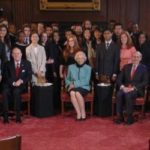
Supreme Court Justices Stephen G. Breyer, Sandra Day O’Connor and Anthony M. Kennedy discuss with high school students this landmark case that ended racial segregation in schools. They explore the background of the case, the role of Thurgood Marshall, how Brown v. Board of Education was decided, and the events following the unanimous ruling that said that “separate education facilities are inherently unequal.” A PDF lesson plan accompanies this video.
Brown v. Board of Education and its Effects on Civil Rights
Larry Kramer, former Dean of Stanford Law School and constitutional scholar, discusses Brown v. Board of Education and its effect on civil rights, and the question of resolving segregation.
Brown v. Board of Education (1954) eLesson
After the Civil War, the 14th Amendment was passed to grant citizenship to former slaves and protect them from civil rights violations in their home states. Public schools were relatively rare throughout the United States, but were often segregated by race where they existed. The same Congress that passed the 14th Amendment created racially segregated schools for the District of Columbia. In the 20th century, the National Association for the Advancement of Colored People (NAACP) began a litigation campaign designed to bring an end to state mandated segregation, calling attention to the shabby accommodations provided for blacks, as well as arguing the damaging psychological effects that segregation had on black school children. One case was brought on behalf of Linda Brown, a third-grader from Topeka, Kan.
Engel v. Vitale (1962)
Does the recitation of a prayer in public schools violate the Establishment Clause of the First Amendment? A Jewish student sued a New York school board over the daily recitation of a prayer. Middle school level also available.
The Pursuit of Justice
The Pursuit of Justice book, written by Kermit L. Hall and John J. Patrick, analyzes 30 Supreme Court cases chosen by a group of Supreme Court justices and leading civics educators as the most important for American citizens to understand. An additional 100 significant cases included in state history and civics standards are summarized. The complete book or individuals chapters can be downloaded.
Davis v. Monroe (1999)
Can a school board be held responsible under Title IX for “student-on-student” harassment? This case summary shows how the Supreme Court answered that question in 1999.
Our Constitution: A Conversation

Justices Sandra Day O’Connor and Stephen G. Breyer talk to high school students about why we need a written Constitution and what it says about the U.S. Supreme Court and its rulings.
Our Rights
The book Our Rights, written by David J. Bodenhamer, uses historical case studies to explore the rights in the Constitution. Supreme Court cases are used to demonstrate how a right received its modern interpretation, how the right applies today, and how courts and other interpreters seek to balance this right with important societal concerns such as public safety. The complete book or individual chapters can be downloaded.