While the Reconstruction Amendments were an important step in ensuring equal rights for all people, regardless of race, racial injustices throughout the United States continued into the late 19th and 20th centuries, leading to the Civil Rights movement of the 1960s, and the passages of Supreme Court decisions and legislation, including Brown v. Board of Education, the Civil Rights Act of 1964, and the Voting Rights Act of 1965. Visit the National Constitution Center’s learning module to learn more about the freedom struggle and civil rights.
Women & the American Story: Confidence and Crises, 1920-1948
This free curriculum unit from the New-York Historical Society considers what it meant to be American in the decades following World War I. Materials focus on the tensions caused by the social, economic, and political shifts of the era and how women took action on a broad array of issues.
Court Shorts: Separation of Powers
In a five-minute video, federal judges offer insights into their thinking about the separation of powers and describe how healthy tensions among the branches have a stabilizing effect on democracy. The judges also share their respect for and commitment to this founding principle, which has an impact on everyday American life.
African American Religious Leadership and the Civil Rights Movement
The modern Civil Rights Movement was the most important social protest movement of the twentieth century. People who were locked out of the formal political process due to racial barriers were able to mount numerous campaigns over three decades to eradicate racial injustice and in the process transform the nation. In its greatest accomplishment, the Civil Rights Movement successfully eliminated the American apartheid system popularly known as Jim Crow. Registration is required to view this resource. Free registration for students and teachers required to access resource.
“Corner Stone” Speech
This speech was delivered in Savannah after Georgia and six other states had seceded from the Union but before hostilities had begun with the Confederate assault on Fort Sumter. Stephens lauded the Confederate states for rejecting the radical theories of Thomas Jefferson and the American founders and establishing instead, for the first time in history, a government resting upon the self-evident truth of racial inequality.
A Conversation on Brown v. Board of Education
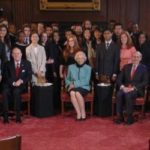
Supreme Court Justices Stephen G. Breyer, Sandra Day O’Connor and Anthony M. Kennedy discuss with high school students this landmark case that ended racial segregation in schools. They explore the background of the case, the role of Thurgood Marshall, how Brown v. Board of Education was decided, and the events following the unanimous ruling that said that “separate education facilities are inherently unequal.” A PDF lesson plan accompanies this video.
Patriotism Crosses the Color Line: African Americans in World War II
Professor Clarence Taylor reminds us of the role African American soldiers played in the conflict—and the role their military service played in shaping the racial politics that followed in peacetime. This essay helps us appreciate the complexity of mobilization for modern warfare and drive home the impact of events on the world stage upon domestic affairs. Free registration for students and teachers required to access resource.
In Pursuit of Equity: Women, Men, and the Quest for Economic Citizenship in 20th-Century America
Alice Kessler-Harris of Columbia University discusses citizenship for men and women in the context of the Industrial Revolution and increasing economic tensions.
Parents Involved v. Seattle (2007)
Does the Equal Protection Clause forbid school districts from using a race-conscious student assignment plan to promote racial integration? This case summary shows how the Supreme Court answered this question in 2007.
Ricci v. DeStefano (2009)
Can an employer reject the results of an employment test because one racial group scored substantially higher than others? This case summary shows how the Supreme Court answered this question in 2009.