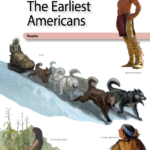
Across 17 lessons, this unit introduces some of the different peoples who populated America many years before the arrival of European explorers—some as early as thirty thousand years ago along the Pacific Coast, and others who traveled from Asia across Beringia, the land bridge. Students explore how these early peoples spread across North and South America, adapted to their environments and developed unique cultures. Each lesson is designed to last 30 minutes.
The Age of Exploration (CKHG Unit)
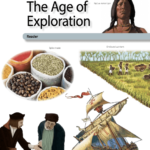
This unit introduces students to European exploration and trade from 1400 to the 1600s. Across 12 lessons, students learn about motivations for European exploration and study specific explorers, learning about their encounters with indigenous peoples. Students are introduced to the early slave trade and the beginnings of slavery in the Americas.
Native Americans: Cultures and Conflicts (CKHG Unit)
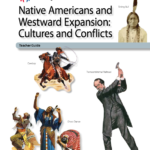
Across 7 lessons, this unit explores the ways of life of diverse Native American peoples and how their cultures were disrupted, displaced, and profoundly altered by westward expansion and American government policies and practices in the 1800s. Some of the content of this unit is tied to the “Pathway to Citizenship,” an array of civics-focused knowledge, questions, and activities.
NHD Breaking Barriers: Americans and Native Americans
From the colonial era, relations between European settlers and Native American nations have been complicated. In 1803 Congress authorized and funded an expedition led by Meriwether Lewis and William Clark for exploration of the region and for better knowledge about American Indians of the Northwest in order to develop trade. About 30 years later, the United States forced the removal of Native Americans from their lands to make way for white American settlement. Congress and the president made treaties with Native American nations, but those treaties were not always respected as the United States continued to expand into the west. After Native Americans enlisted and served in both World War I and World War II, Congress passed legislation to begin to address longstanding Native Americans claims against the United States Government.
Indian Boarding Schools Primary Source Set
Through photographs, letters, reports, interviews, and other primary documents, students explore the forced acculturation of American Indians through government-run boarding schools.
American Indian Reservation Controversies
Reservation Controversies covers historic issues dealing with American Indian Reservations in the 1870s. This experience uses problem based learning (PBL), in which the student is confronted or faced with a real world problem which has no preconceived right or wrong answers. This scenario puts the student as prospective Indian Agent for the Comanche Indian reservation in 1873. Using various teaching/learning strategies, which include brainstorming, role playing, and oral presentations, the students access primary sources and other background sources to arrive at a recommendation, based on the information. The teacher, librarian, and other support staff act as guides or advisors through most of the process.
Tribal Government
This lesson examines the varied structures and functions of tribal government as well as the relationship these nations have with the United States.
Native American-European Contact in Colonial Times
Drawing on the concept of worldview, students learn to think critically about the cultural differences between Europeans and Native Americans, and how those differences shaped interaction and potential misunderstandings between the groups as they negotiated trade and diplomatic relationships.
Early Encounters Between Native Americans and Europeans
Students may come to recognize how the later period of continued exploration, settlement, and interaction was influenced by these early encounters from the St. Lawrence River to Georgia. Free registration for students and teachers required to access resource.
Native American Housing
Native American housing is frequently assumed to be represented by one or two well-known styles such as the teepee or pueblo. While these do reflect distinct tribal designs, they are not all inclusive and students should be exposed to a wider range of design. The lesson should also help students understand the relationship between environment and housing. Free registration for students and teachers required to access resource.